The Fluoride-Groundwater-Health System
tags: #hydrogeology/ciremai #contamination/fluor #hydrogeology/volcanic #hydrogeology/contaminant #maria #hydrogeology/urban
Abstract
This study synthesizes a body of literature to construct a systematic concept map addressing environmental contamination and its multi-dimensional impacts. The analyzed papers cluster into a coherent “fluoride–agriculture–groundwater–health” system, organized across distinct thematic layers. By mapping the pathways from agricultural practices and hydrogeological dynamics to groundwater quality, this framework illustrates how environmental factors directly translate into public health risks. Ultimately, this integrated conceptual model serves as a valuable tool for researchers and policymakers to understand the holistic dynamics of fluoride contamination and design targeted mitigation strategies for vulnerable populations.
The analyzed literature systematically clusters into a coherent “fluoride–agriculture–groundwater–health” system, mapping a clear upstream-to-downstream relationship. Through distinct thematic layers, this system illustrates how hydrogeological dynamics and agricultural activities interact to influence groundwater quality, ultimately determining the public health risks faced by dependent populations. The papers cluster into a coherent fluoride–agriculture–groundwater–health system, with clear thematic layers.
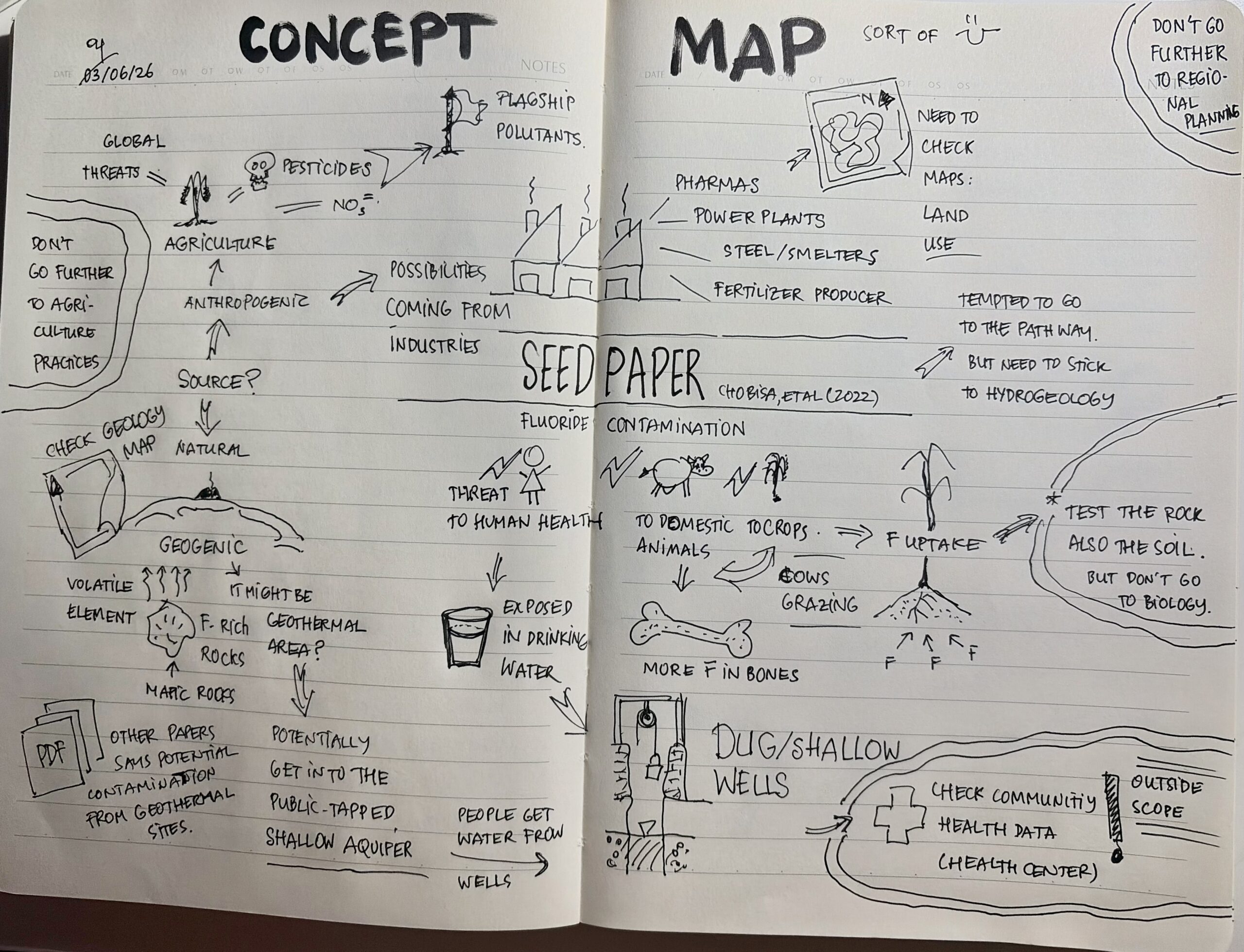
1. Seed paper as the core node
Core node: Fluoride contamination of groundwater and its threat to health of villagers and their domestic animals and agriculture crops in rural Rajasthan, India (Choubisa et al., 2022).
Conceptually, this sits at the center of the map and links four domains:
- Groundwater hydrogeochemistry (fluoride in rural Rajasthan aquifers).
- Human health (villagers consuming F‑rich water and food).
- Domestic animals (livestock drinking/feeding from contaminated sources).
- Agriculture (crops irrigated with F‑rich water, possibly affected in yield/quality).
Everything else in our list can be read as elaborations of one or more of these four domains, plus sources and diagnostics.
2. Source domain: where the fluoride comes from
2.1 Geogenic / groundwater system
Node cluster:
- Fluoride Distribution in Drinking Groundwater in Rajasthan, India (2018).
- Is drinking groundwater in India safe for human health in terms of fluoride? (2023).
These define spatial patterns and risk levels in groundwater, and feed directly into:
- Seed paper’s “contamination of groundwater” component.
- All human and animal fluorosis nodes (they’re downstream of this exposure).
We can see this as:
Geology–Hydrogeology → Groundwater F distribution → Seed paper & all exposure studies.
2.2 Industrial and agro‑environmental sources
Node cluster:
- Status of industrial fluoride pollution and its diverse adverse health effects in man and domestic animals in India (2016).
- Neighbourhood fluorosis in people residing in the vicinity of superphosphate fertilizer plants near Udaipur city of Rajasthan (India) (2015).
- “Is Industrial Fluoride Pollution Harmful to Agricultural Crops? Farmers Need to Know” (2023).
These add industrial emissions and fertilizer industry as additional sources, connecting to:
- Soil and crops near industrial facilities (agriculture‑side contamination).
- Human/animal fluorosis in industrial belts.
- The seed paper’s “agriculture crops” node via industrial fallout and fertilizer use.
The “source” layer has two big sub‑nodes: geogenic F in aquifers and industrial/industrial‑agricultural F.
3. Exposure and receptors: humans, animals, crops
3.1 Humans: villagers, tribals, children
Node cluster:
- STATUS OF CHRONIC FLUORIDE EXPOSURE AND ITS ADVERSE HEALTH CONSEQUENCES IN THE TRIBAL PEOPLE OF THE SCHEDULED AREA OF RAJASTHAN, INDIA (2021).
- Fluoride in Drinking Water and its Toxicosis in Tribals of Rajasthan, India (2012).
- Fluorosis in subjects belonging to different ethnic groups of Rajasthan, India. (2007).
- Osteo-dental fluorosis in relation to nutritional status, living habits, and occupation in rural tribal areas of Rajasthan, India. (2009).
- GENU-VALGUM IN FLUOROSIS-ENDEMIC RAJASTHAN AND ITS CURRENT STATUS IN INDIA (2018).
- A Brief Review of Fluoride Exposure and Its Adverse Health Effects Among Tribal Children in India (2025).
- Chronic fluoride intoxication (fluorosis) in tribes and their domestic animals (1999).
These connect to the seed paper’s “health of villagers” node, and specify:
- Population types (tribal vs other ethnic groups).
- Health endpoints (osteo‑dental fluorosis, skeletal deformities like genu valgum).
- Modifiers (nutrition, occupation, living habits, age/children).
Graphically:
Groundwater + Industry → Human exposure (drinking water, food) → Human health outcomes.
3.2 Domestic animals as receptors (and indicators)
Large, dense node cluster, by species:
- Bovines and calves:
- Fluorotoxicosis in Diverse Species of Domestic Animals Inhabiting Areas with High Fluoride in Drinking Water of Rajasthan, India (2013).
- TOXICITY OF FLUORIDE IN CATTLE OF THE INDIAN THAR DESERT, RAJASTHAN, INDIA (2013).
- Bovine calves as ideal bio-indicators for fluoridated drinking water and endemic osteo-dental fluorosis (2014).
- Chronic Fluoride Exposure and its Diverse Adverse Health Effects in Bovine Calves in India: An Epitomised Review (2021).
- A brief review of industrial fluorosis in domesticated bovines in India: Focus on its socio-economic impacts on livestock farmers (2023).
- Water buffaloes:
- A Brief and Critical Review of Chronic Fluoride Poisoning (Fluorosis) in Domesticated Water Buffaloes (Bubalus bubalis) in India: Focus on its Impact on Rural Economy (2022).
- Is the Water Buffalo Species (Bubalus bubalis) Relatively more Sensitive to Fluorosis than other Species of Domestic Animals? (no year in text).
- Goats and sheep:
- INDUSTRIAL FLUOROSIS IN DOMESTIC GOATS (CAPRA HIRCUS), RAJASTHAN, INDIA (2014).
- FLUORIDE TOXICOSIS IN IMMATURE HERBIVOROUS DOMESTIC ANIMALS LIVING IN LOW FLUORIDE WATER ENDEMIC AREAS OF RAJASTHAN, INDIA: AN OBSERVATIONAL SURVEY (2013).
- Natural amelioration of fluoride toxicity (fluorosis) in goats and sheep. (2010).
- Camels:
- FLUOROSIS IN DROMEDARY CAMELS IN RAJASTHAN, INDIA (2006).
- Fluorosis in Dromedary camels in Rajasthan, India. (2010).
- A Brief Review of Endemic Fluorosis in Dromedary Camels (Camelus Dromedarius) and Focus on Their Fluoride Susceptibility (2023).
- Equines (horses, donkeys):
- Osteo-dental fluorosis in domestic horses and donkeys in Rajasthan, India. (2010).
- Chronic fluoride poisoning in domestic equines, horses (Equus caballus) and donkeys (Equus asinus (2023).
- Ruminants, mixed domestic animals:
- FOOD, FLUORIDE, AND FLUOROSIS IN DOMESTIC RUMINANTS IN THE DUNGARPUR DISTRICT OF RAJASTHAN, INDIA (2006).
- Some Observations on Endemic Fluorosis in Domestic Animals in Southern Rajasthan (India) (1999).
- OBSERVATIONS OF FLUOROSIS IN DOMESTIC ANIMALS OF THE INDIAN THAR DESERT, RAJASTHAN, INDIA (2014).
- Fluoridated ground water and its toxic effects on domesticated animals residing in rural tribal areas of Rajasthan, India (2007).
- Status of Fluorosis in Animals (2012).
- Wildlife:
- Can Fluoride Exposure be Dangerous to the Health of Wildlife? If so, How can they be Protected from it? (no year in text).
All of these radiate from two upstream nodes:
- Groundwater/industrial F contamination.
- Agriculture: fodder, irrigation water, grazing on contaminated lands.
They also loop back into:
- The seed paper’s “domestic animals” node.
- Socio‑economic impacts on rural livestock farmers (bovines, buffaloes).
3.3 Crops and agricultural system
This is less dense but crucial for our “fluoride from agriculture” focus:
- Seed paper’s explicit “agriculture crops” impact.
- “Is Industrial Fluoride Pollution Harmful to Agricultural Crops? Farmers Need to Know” (2023).
These link:
- Industrial F (fertilizer plants, emissions) → crop contamination and possible yield/quality impacts.
- Irrigation with F‑rich groundwater → soil and plant F uptake.
In the map, crops form the bridge between hydrogeochemical contamination and food/feed pathways into animals and humans.
4. Diagnostics, indicators, and methods
These are “tool” nodes that connect to many receptor nodes:
- A Brief Review of Ideal Bio-Indicators, Bio-Markers and Determinants of Endemic of Fluoride and Fluorosis (2021).
- Radiological Findings More Important and Reliable in the Diagnosis of Skeletal Fluorosis (2022).
- How Can Fluorosis in Animals be Diagnosed and Prevented? (2022).
- 13-33 sfs 511 Choubisa review May 23 1539.fm (likely a broad review).
They sit between:
- Exposure (groundwater/food/air)
- Outcomes (human/animal fluorosis, skeletal changes, clinical signs)
that give the following:
- Criteria for endemicity.
- Candidate bio‑indicators (bovine calves, specific species, radiological markers).
- Guidance on surveillance and prevention.
From a “knowledge map” perspective, they are cross‑cutting nodes that connect most of the species‑ and human‑health clusters back to the core contamination system.
5. Cross‑cutting reviews and syntheses
A few nodes are meta‑layers:
- A brief and critical review on hydrofluorosis in diverse species of domestic animals in India (2018).
- Status of Fluorosis in Animals (2012).
- Various species‑specific “brief review / epitomised review” papers (bovine calves, water buffaloes, camels, bovines and socio‑economic impacts).
These sit above the detailed empirical nodes and:
- Summarize patterns across regions/species.
- Emphasize economic and social consequences for agriculture (livestock productivity, farmers’ livelihoods).
- Help us define system‑level hypotheses for our own modeling (e.g., species‑dependent sensitivity vs. exposure pathways in agri‑systems).
6. Putting it together as a “systematic” concept map
To assemble a systematic concept map, the key domains (big nodes) are structured around a coherent “fluoride–agriculture–groundwater–health” system. These domains serve as the primary thematic layers of the map, illustrating how agricultural activities and hydrogeological factors interact to influence groundwater quality, thereby mapping a direct pathway to public health outcomes.
- Sources
- Geogenic F in aquifers (bedrock, hydrogeology).
- Industrial/industrial‑agricultural F (fertilizer plants, emissions, F‑rich fertilizers).
- Pathways
- Groundwater abstraction → drinking water + irrigation.
- Atmospheric deposition → soils, crops, surface water.
- Food–fodder chain → crops, forage, animal products.
- Receptors
- Villagers/tribal populations (with modifiers: occupation, nutrition, ethnicity, age).
- Domestic animals (bovines, buffaloes, goats, sheep, camels, equines, ruminants).
- Wildlife.
- Agricultural crops (yield, quality, physiology) and, indirectly, rural economy.
- Outcomes
- Osteo‑dental fluorosis and skeletal fluorosis.
- Specific deformities (genu valgum) and radiological changes.
- Productivity loss: animals, crops, human labor, and farmer income.
- Observation & Control
- Bio‑indicators and biomarkers (bovine calves, species sensitivity).
- Diagnostic tools (radiology, clinical signs).
- Prevention and mitigation (testing surface water, management recommendations, natural amelioration in animals).
- Operationalize the concept map
This map suggests:
- Treat agriculture as both receptor and amplifier:
- Irrigation and deposition load F into soils and crops.
- Crops/forage transfer F into livestock and humans.
- Livestock fluorosis becomes an integrative indicator of agri‑hydrogeological exposure.
- Use the Choubisa corpus as layers in a conceptual model:
- Groundwater distribution papers → spatial F fields.
- Industrial papers → localized source terms, especially near fertilizer plants.
- Animal/human health papers → empirical “response” data at different exposure levels.
- Diagnostic/bio‑indicator papers → criteria for validating our model outputs.
- Identify gaps where the hydrogeology + modeling can plug in:
- Little explicit quantification of F mass balance in irrigated systems.
- Limited dynamic/temporal analysis relative to expansion of irrigation or industry.
- No coupled model of “groundwater–soil–crop–animal–human” as a unified F cycle in rural Rajasthan.
Remarks
- The analyzed literature groups into a unified and structured framework rather than remaining as isolated studies.
- It establishes a highly interconnected system linking fluoride dynamics, agricultural practices, groundwater resources, and public health.
- The research is organized into distinct, well-defined thematic layers that simplify complex environmental interactions.
- It maps a clear pathway showing how agricultural and geological factors directly influence water quality and human health.
- This systematic alignment provides a coherent, holistic model for understanding environmental contamination and its societal impacts.