Over the past decade, while most of us were still arguing about APCs and impact factors, a quiet but determined experiment has been unfolding inside Earth and planetary sciences. A group of researchers, editors, and open science activists have not only complained about commercial publishing, they have actually built an alternative: a visible ecosystem of diamond open access journals that now spans volcanology, seismology, tectonics, geomorphology, sedimentology, geochemistry, palaeontology, and planetary science.
The preprint “The Rise of Diamond Open Access Journals in Earth Sciences: Past Developments, Present Tensions, and Future Pathways” tells that story from the inside. Many of the authors are founding editors or steering‑committee members of the very journals they describe. That positionality matters. This is not an abstract policy discussion. It is a narrative of practitioners who decided that if the system is broken, they will fix at least one corner of it themselves.
Diamond open access is not an accident in Earth sciences
The paper starts from a simple observation: the culture of open, society‑supported publishing in Earth sciences is older than the buzzword “diamond open access”. Geological surveys, learned societies, and institutional series have been putting out free‑to‑read, low‑cost work for decades. In that sense, the rise of today’s diamond journals is not a revolution but a return.
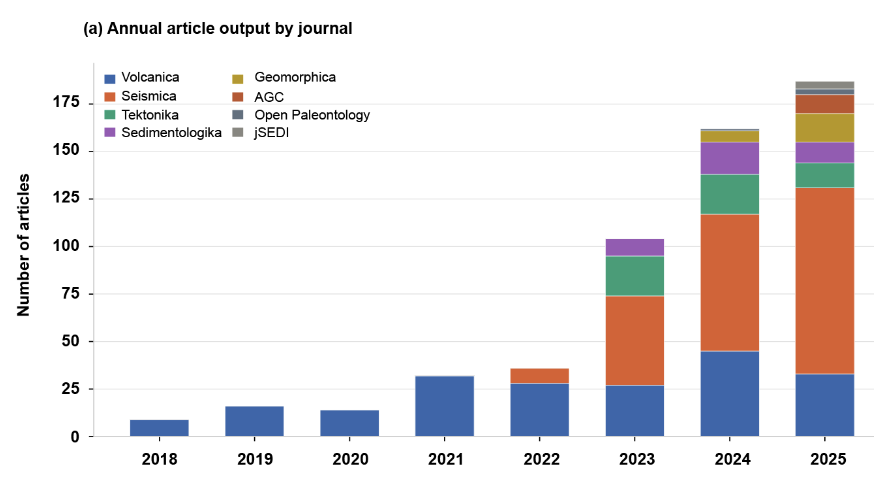
What changed around the mid‑2010s was visibility and intentionality. Journals such as Volcanica, Seismica, Tektonika, Geomorphica, Sedimentologika, Advances in Geochemistry and Cosmochemistry, Open Palaeontology, Planetary Research, and the Journal of Studies of Earth’s Deep Interior did not just happen to be free for readers and authors. They explicitly branded themselves as diamond and community‑governed. They published editorials that read almost like manifestos. They made governance structures transparent. They framed their existence as a response to what the paper calls “knowledge (b)locking” by paywalls and article processing charges.
In other words, Earth sciences did not simply adopt a new business model. It adopted a new language for talking about scholarly publishing: commons, digital public goods, equity, decolonizing, data justice. The authors connect their story to global conversations led by UNESCO and cOAlition S, which define diamond open access as a public‑interest model: no fees for authors or readers, shared infrastructures, open licences, multilingualism, and a strong emphasis on bibliodiversity.
From “no APCs” to sociotechnical experiments
One of the keys to reading this paper is to see that it insists on diamond as more than a pricing scheme. The authors argue that these journals are sociotechnical experiments in at least three dimensions.
First, they are experiments in regaining agency. Editorial control, platform choices, and policies are moved back into the hands of academic communities, instead of being defined by large commercial publishers. In many cases, the same people who review and write papers now also design peer review workflows, build editorial boards, and make decisions about licensing.
Second, they are experiments in redistributing labour. Traditional commercial models hide a lot of free academic work behind glossy platforms and high subscription prices. Diamond journals make that labour visible. The paper openly acknowledges that these ventures rely on intense volunteer coordination: editors, copyeditors, technical staff, and governance committees who are often not paid at market value, if at all. That visibility is both a strength and a vulnerability.
Third, they are experiments in redefining value. The authors are frank about the tension here. We still live in a world where research assessment is wired to prestige indicators that favour big commercial brands and their metrics. Diamond journals try to push against that logic by focusing on community relevance, openness, and equity. But they operate inside evaluation systems that still reward the old currencies. This is why the paper repeatedly comes back to research assessment reform as a non‑negotiable precondition for scaling the model.
Three main claims about where we stand now
From this narrative, the paper develops three central claims about the current state and future of diamond open access in Earth sciences.
The first claim is that the “diamond turn” in Earth sciences has been enabled by pre‑existing community infrastructures and strong volunteer cultures, but that it remains uneven and fragile. Certain subfields with tight international networks and a strong identity—volcanology, tectonics, seismology, geomorphology, sedimentology—have been fertile ground for community‑led journals. Other areas lag behind. Technical infrastructure is often stitched together from grants, institutional goodwill, and the work of a few committed individuals. There is no guarantee of long‑term stability.
The second claim is that diamond models clearly strengthen equity for both authors and readers. By definition, they remove two major barriers: the paywall for access and the APC for publication. For researchers without generous grants or from institutions in the global South, this matters a lot. At the same time, the authors warn that this equity on the surface can hide unresolved tensions. Who pays for the infrastructure in the long run? Who performs and is credited for the editorial and technical labour? How do we ensure that free‑to‑publish does not quietly translate into “free work” from the same overburdened segments of the community?
The third claim is more ambitious. The authors position Earth sciences as a strategically important testbed for a wider transition towards commons‑based scholarly communication. They argue that Earth sciences sit at the intersection of global fieldwork, environmental justice, indigenous knowledge, and strong international collaborations. Because of that, they claim, this field has both the need and the legitimacy to pioneer alternatives to pay‑to‑read and pay‑to‑publish logics. Diamond journals, in this view, are one of the laboratories where we can test what it means to publish as a public good rather than a commodity.
Problems are described in order to search for solutions
The paper does not simply celebrate the new journals. It spends a fair amount of time on what is not yet working, with an eye to solutions.
On the financial side, the authors accept that relying solely on sporadic grants and altruism is not sustainable. They call for “durable funding compacts”, where research institutions, funders, and perhaps consortia of libraries commit to long‑term support for community‑led platforms. This echoes wider discussions in Europe and beyond about redirecting some of the money currently flowing into APCs and subscription packages toward shared infrastructures.
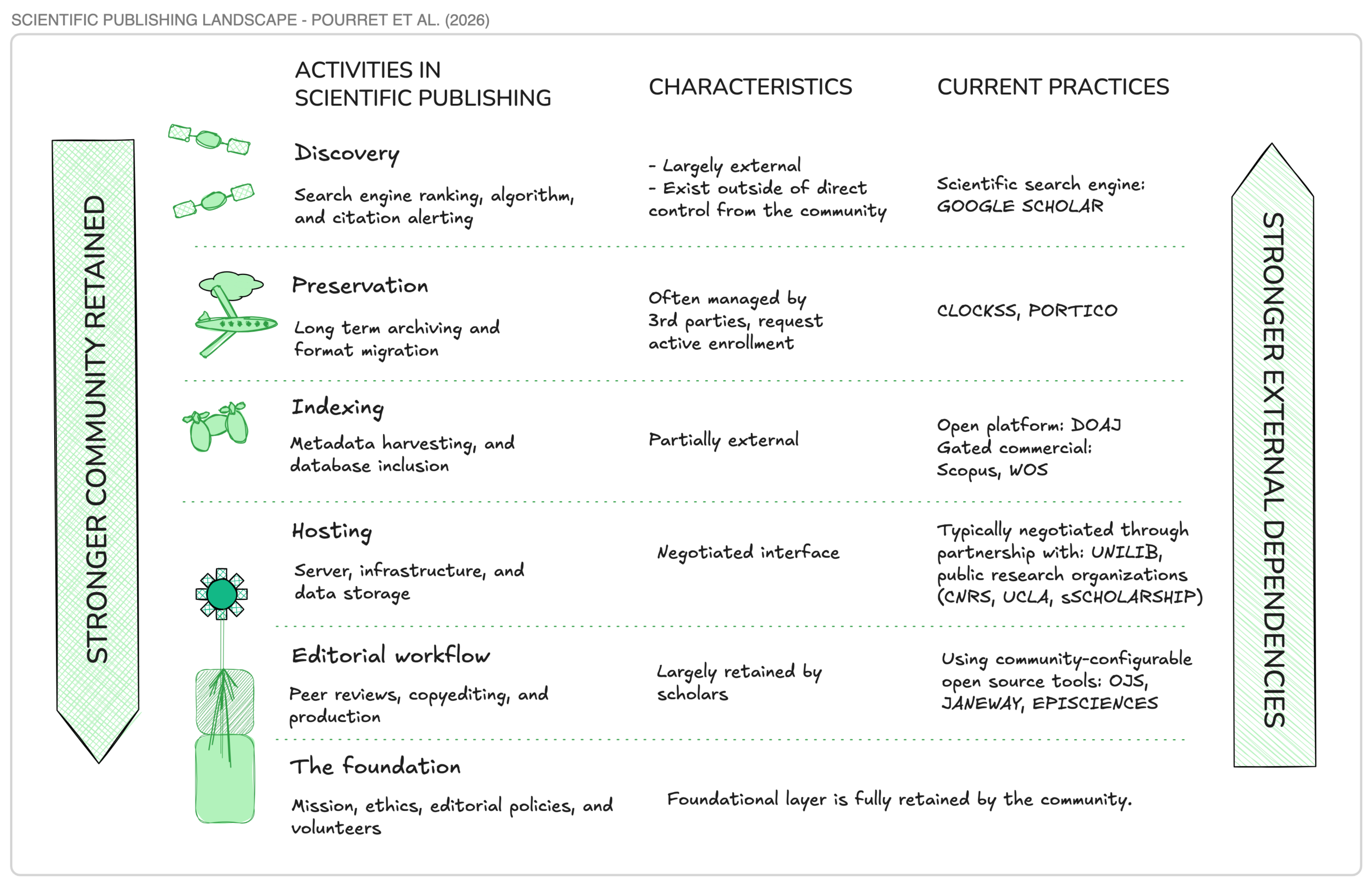
On the technical side, they highlight the need for shared platforms, preservation services, metadata systems, and indexing strategies that can be used across many journals. The aim is to avoid each journal reinventing the wheel on its own and to give diamond outlets the same level of discoverability and robustness that commercial platforms already provide.
On the cultural side, the paper returns repeatedly to research assessment. As long as hiring, promotion, and funding committees lean heavily on journal brands and commercial metrics, diamond journals will struggle to be seen as “serious” options, especially by early‑career researchers. The authors align themselves with movements for responsible research assessment, arguing that if we change what counts as quality and impact, we create space for community‑owned venues to thrive without imitating the prestige games of the commercial sector.
https://commons.wikimedia.org/wiki/File:Scientific_publishing_landscape.png

A testbed with global implications
Although the focus is squarely on Earth sciences, the narrative clearly looks beyond the field. The authors see their experience as a contribution to a broader transformation of scholarly communication. They connect Earth‑science diamond journals with global policy documents that frame scholarly knowledge as a digital public good. They point towards intersections with preprints, FAIR data, and open peer review as parts of a coherent ecosystem.
In that sense, the story they tell is not only about how Earth scientists publish. It is about who owns the means of producing, validating, and distributing knowledge in the 21st century, and about how a specific discipline can use its own institutional history to help shift that ownership.
A cautious but hopeful conclusion
By the end of the preprint, a clear pattern emerges. The authors are convinced that diamond open access, in its current Earth‑science form, is a more equitable and intellectually honest way to communicate research than the dominant commercial models. At the same time, they are honest about its fragility. Without stable funding, shared technical infrastructure, and deep reform of how we evaluate researchers, diamond journals risk becoming islands maintained by exhausted volunteers.
The conclusion is therefore both optimistic and pragmatic. The Earth‑science community has already shown that it can build functioning diamond journals at scale, in multiple subfields, with international reach. The next decade, the paper suggests, should be dedicated to turning these islands into a durable archipelago: an interconnected, publicly supported ecosystem that treats scholarly publishing as part of our shared scientific infrastructure, not as a luxury service.
In other words, the experiment is underway. The question now is whether the wider research system is willing to adjust its incentives, budgets, and assessment practices so that this experiment can move from the margins to the mainstream.
About the authors
The authors of this preprint form a kind of “diamond OA all‑stars” team across the Earth and planetary sciences. They are spread over Europe, Asia, Australia, and North America, and nearly all are directly involved in building or running community‑led journals.
The paper is led by Olivier Pourret from UniLaSalle, AGHYLE, in Beauvais, France, a geochemist who has been a persistent voice on equity and open access in geochemistry. He is joined by Maëlis Arnould (Lyon 1 Université / ENS Lyon / UJM / CNRS, LGL‑TPE, France) and Thibault Duretz (Goethe‑Universität Frankfurt, Germany), both with strong roots in geodynamics and tectonics. From Japan, Jamie I. Farquharson brings experience in research administration at Niigata University and in volcanology and open science advocacy.
The team includes contributors from Indonesia, Europe, and the US such as Dasapta Erwin Irawan (Institut Teknologi Bandung, Indonesia), an applied geologist and open science champion; Larry Syu‑Heng Lai (Bureau of Economic Geology, University of Texas at Austin, USA) and Alice Lefebvre (MARUM, University of Bremen, Germany), both active in sedimentology and geomorphology. Craig Magee (University of Leeds, UK) and Marc‑Alban Millet (Cardiff University, UK) add expertise in structural geology and geochemistry.
On the scholarly communication and library side, Samantha Teplitzky from the University of California, Berkeley, contributes a library and publishing‑services perspective. The group is rounded out by Camille Thomas (University of Bern, Switzerland), Romain Vaucher and Lauren Waszek (James Cook University, Australia), Mark A. Wieczorek (IPGP / Université Paris Cité, France), and Thomas W. Wong Hearing (University of Leicester, UK), covering planetary science, paleontology, and Earth’s deep interior.
Many of these authors are not just academics in their subfields: they are founding editors, editors‑in‑chief, or steering‑committee members of key diamond open access journals such as Volcanica, Seismica, Tektonika, Geomorphica, Sedimentologika, Advances in Geochemistry and Cosmochemistry, Open Palaeontology, Planetary Research, and jSEDI. That collective editorial experience is exactly what underpins the analysis presented in the paper.